

Pre-engineered buildings (PEBs) have revolutionized modern construction with their strength, cost-efficiency, and rapid assembly. But one question often arises for engineers, contractors, and clients alike: How do pre-engineered buildings perform during worst-case weather scenarios—like cyclones, floods, extreme heat, snow, or seismic events?
In this blog, we explore the resilience of PEBs under extreme conditions and why they’re increasingly becoming the preferred choice across various industries and geographies.
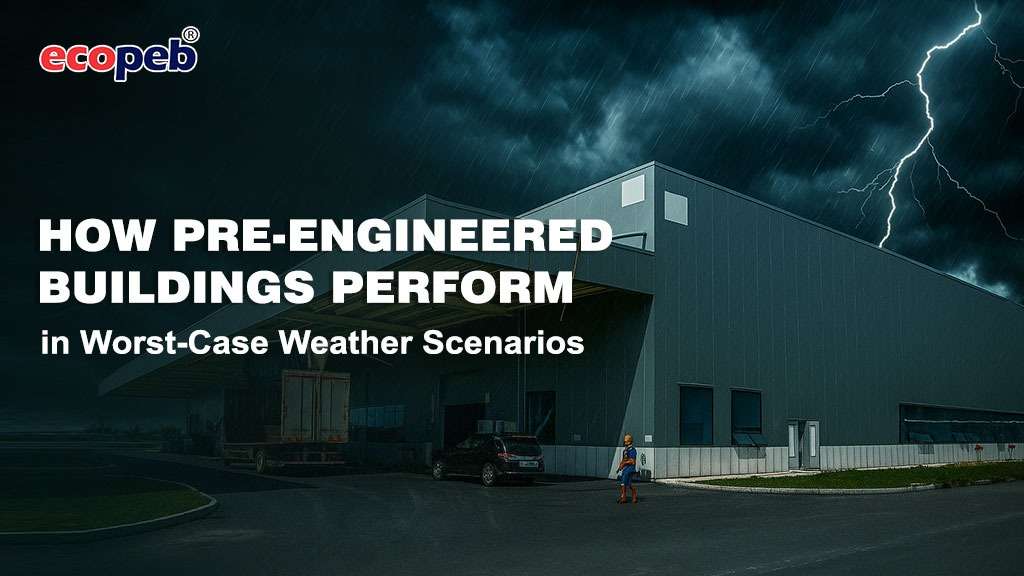
Wind and Cyclone Resistance: Engineered to Withstand High-Velocity Winds
One of the primary concerns for structures, especially in coastal or storm-prone regions, is their ability to withstand high-speed winds and cyclones. PEBs are custom-engineered to meet local wind load requirements, making them highly effective against stormy weather.
- Design Precision: The steel frames and connections in a PEB are manufactured with computer-aided precision. Engineers consider factors like wind speed, building height, roof slope, and exposure to open terrain.
- Anchoring and Bracing Systems: Advanced anchoring systems, portal frames, and X-bracing in PEBs enhance structural stability during gusty winds or tornadoes.
- Real-world Performance: In regions like coastal India and hurricane-prone states in the U.S., PEBs have shown remarkable resilience, often remaining intact when traditional buildings suffered damage.
By adhering to the International Building Code (IBC) or the Indian Standard IS 875 (Part 3), PEBs can be designed to withstand winds exceeding 200 km/h.
Seismic Safety: Flexible Yet Strong Pre Engineered Buildings Structures
Earthquakes pose a significant threat to rigid buildings, especially those made from brittle materials. PEBs, in contrast, offer excellent seismic performance due to their lightweight, flexible design and ductile materials.
- Steel’s Ductility: Unlike concrete, steel structures bend without breaking, allowing PEBs to absorb and dissipate seismic energy.
- Joint Integrity: Bolted and welded joints in PEBs are designed to handle multidirectional movement.
- Foundation Flexibility: Depending on the seismic zone, engineers can modify the foundation and base plate anchoring for added protection.
In earthquake-prone areas like the Himalayas or California, PEBs are increasingly favored for factories, warehouses, and emergency shelters due to their quake-resilient characteristics.
Flood Resistance and Water Management
Floods can compromise the structural integrity of traditional buildings and destroy internal components. However, pre-engineered buildings can be designed with effective flood resistance in mind.
- Elevated Foundations: PEBs can be constructed on elevated concrete plinths or stilts to avoid water ingress during flash floods.
- Waterproofing Options: Metal panels used in PEBs can be treated with anti-corrosive coatings, and waterproof sealants are applied at joints and edges to prevent leakage.
- Drainage Solutions: Integrated gutter and downspout systems ensure efficient rainwater drainage, reducing water buildup around the foundation.
Proper site planning, combined with structural customization, makes PEBs suitable for flood-prone and high-rainfall regions.
Thermal Performance in Extreme Heat and Cold
Another concern with metal buildings is how they perform under extreme temperature variations, from scorching desert heat to freezing alpine conditions. PEBs address these challenges with smart design and material selection.
- Insulated Panels: Sandwich panels or double-skin roofing systems with insulation (like rockwool or polyurethane) help maintain internal temperatures.
- Ventilation and HVAC Integration: PEBs support advanced ventilation systems, ridge vents, and solar-powered exhausts for passive cooling.
- Snow Load Resistance: In cold regions, PEBs are engineered with specific snow load calculations, ensuring that roof structures can safely bear heavy snow accumulation without deformation.
Whether it’s +50°C in Rajasthan or -20°C in Ladakh, pre-engineered steel buildings can be tailored to offer optimal comfort and energy efficiency.
Fire Safety and Post-Disaster Recoverability
In worst-case scenarios like fires or post-disaster recovery, PEBs again demonstrate an edge over conventional buildings.
- Non-combustible Materials: Steel, by nature, is non-combustible and does not contribute to fire spread. PEBs can also be coated with intumescent fire-resistant paints for additional safety.
- Quick Restoration: If damage occurs due to any extreme weather event, modular PEB components can be replaced quickly without demolishing the entire structure.
- Minimal Debris and Hazard: Steel structures produce less debris compared to RCC buildings in the aftermath of disasters, making cleanup faster and safer.
This quick recoverability makes PEBs ideal for emergency structures, military camps, and disaster-resilient infrastructure.
PEBs Are Built for the Future
Whether it’s hurricanes, earthquakes, floods, or extreme temperatures, pre-engineered buildings are designed to perform exceptionally well in worst-case weather scenarios. Their customisable, code-compliant designs allow builders and clients to create durable, sustainable, and low-maintenance structures.
Key Takeaways:
- PEBs can be engineered for wind, seismic, and snow loads based on geographic location.
- They support rapid recovery and modular repair after disasters.
- Smart insulation, waterproofing, and ventilation ensure energy efficiency and interior comfort in any climate.
As climate change increases the frequency and severity of extreme weather events, PEBs offer a future-ready, climate-resilient construction solution for industries ranging from manufacturing to warehousing, logistics, agriculture, and public infrastructure